
You can find a PDF copy of this Proteus 500 datasheet on our Downloads page.

Proteus 500 Launch and Recovery System (LARS)
The Proteus 500 LARS is an innovative, stand-alone, deck mounted system, that enables the safe launch and recovery of autonomous or semi-autonomous marine equipment; such as ROV, AUV, ASV; under local or remote control.
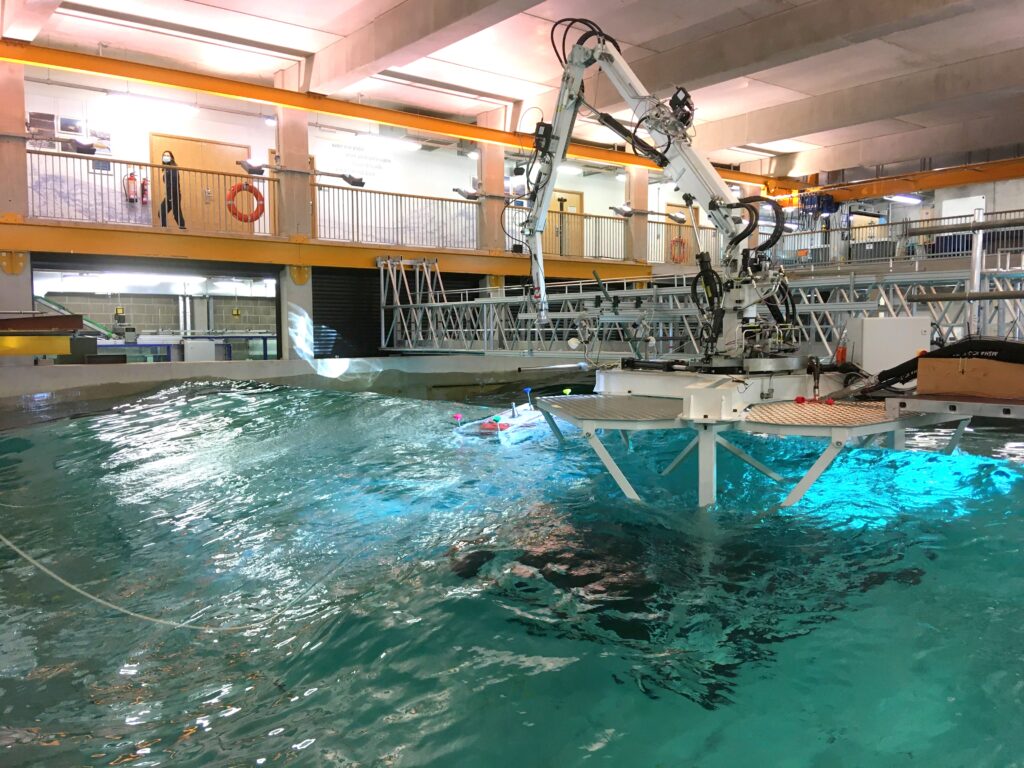
As the host vessel and target (ROV, AUV etc.) are floating they are both subject to wave induced motions. The Proteus control system uses computer vision to automatically synchronise movement of the coupling tool with the target to ease attachment and recovery.
PRINCIPLE:
A stand-alone launch and recovery system that can be installed on any suitable vessel (including autonomous / unmanned surface vessels) and operates without requiring any vessel services or data, except for the optional use of ship-generated electrical power.
DESCRIPTION:
The system consists of an articulated three-section arm mounted on a base frame with slew ring and gimbal (see Figure 1 below). The system is hydraulically actuated and powered by either a vessel generated supply or an optional dedicated hydraulic power unit (HPU), which can be mounted on the base frame. The arm carries an interchangeable coupling tool on the last section, which can automatically latch onto a free-floating target for recovery. When launching targets into the water, the operator controls when the coupling tool releases the payload.
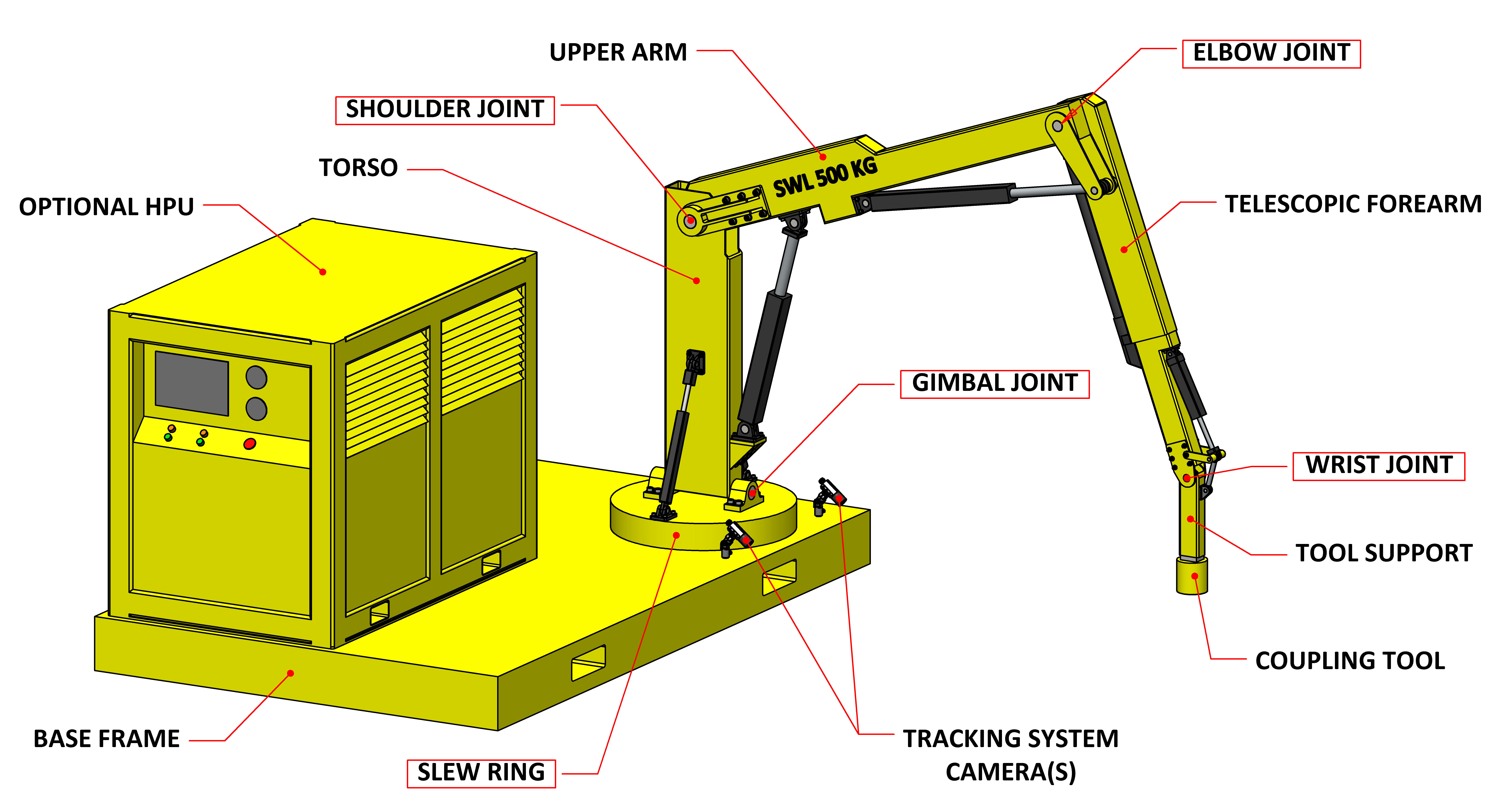
During recovery operations the innovative control system ensures that the slew ring, gimbal and arm sections are moved to compensate for wave-induced motions between the target and host vessel.
To launch the target device, Proteus simply serves as a steerable hoist, latching onto the device on the vessel deck, lifting it clear and over the side of the vessel, then lowering it down into the water, where it is released to depart on its mission.
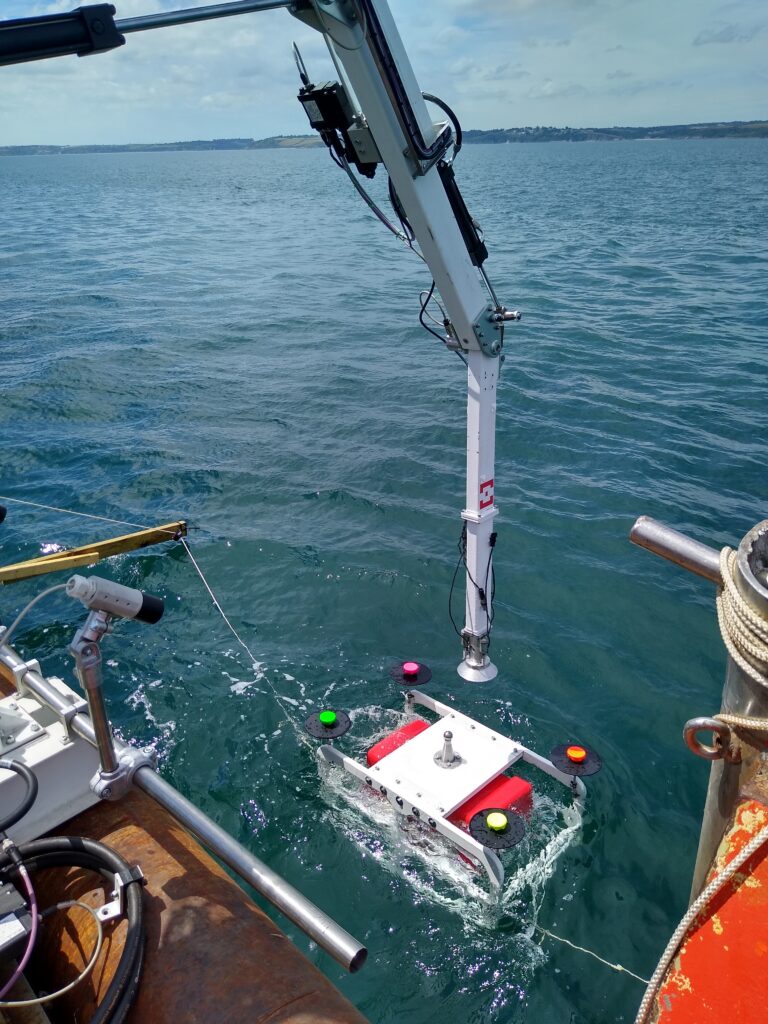
To recover a returning target, it must first manoeuvre into the field of view of Proteus’ tracking system. Proteus is then moved into its starting position, and the tracking system engaged. This will acquire the target’s position, aided by markers on its body, and guide the coupling tool down onto the target’s connection point (see Figure 2 below), automatically tracking and compensating for its relative movement in the water, so it can latch on smoothly and securely. As soon as it has latched, Proteus will lift the target clear of the water. It can then be swung inboard and lowered onto the deck.
MOTION MEASUREMENT:
When synchronously stabilised (i.e. coupling tool motion matched with that of the target to be recovered), a camera based visual tracking system measures the relative motion of the floating target. The Proteus controller uses this camera data to derive the joint angles needed to synchronise the coupling tool with the target. Data from a deck mounted attitude sensor is used by the controller to keep the arm assembly in the vertical plane.
SPECIFICATION*:
| Maximum Payload Weight | 500kg |
| Lift Height Capability | -2.0m to +2.5m |
| Maximum Reach | 4.8m |
| Gimbal Range | +/-15 degrees |
| Slewing Range | 270 degrees |
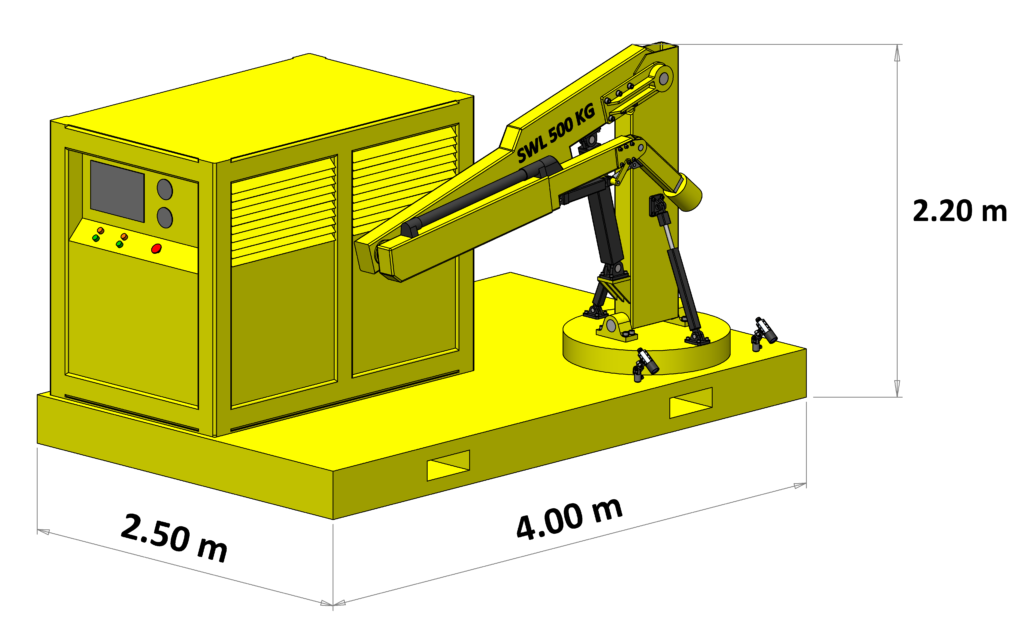
| System Foundation | 4.0m x 2.5m |
| Proteus 500 Weight | 1,000kg |
| Base Frame Weight | 3,000kg |
| HPU (Optional) Weight | 2,500kg |
| Hydraulic Power Requirements | 50kW @ 95 Bar |
PRINCIPAL DIMENSIONS:
Figure 4 shows the Proteus 500 System in its stowed position, which is contained within the base frame’s deck footprint.
FEATURES:
- Simplified LAR process reduces potential hazards to personnel and is less labour intensive
- Light weight design with small footprint allows Proteus to be installed on smaller, more economical vessels
- Telescopic forearm design allows for a greater reach
- Option to integrate hydraulic power unit (HPU) within base frame can reduce the install time and complexity
- The use of a multi-jointed arm allows for operation in areas where height restrictions may present a problem
- Motion compensated design increases system availability and reduces cost by extending the weather window
- Interchangeable coupling tool making it suitable for use with a wide range of ROVs, AUVs, and ASVs
- Designed for local operation on manned vessels or fully remote controlled on autonomous surface vessels
SAFETY:
Design for safety is a key principle and is achieved in the following ways:
- No dependence upon ship’s systems or data beyond vessel station-keeping
- Less chance of damage to host vessel or target during launch and recovery procedures
- Automatic latching of coupling tool to target reduces the possibility of the equipment being dropped
- Optional second camera provides better target acquisition and redundancy should one camera’s view become obscured
OPERATING ENVELOPE:
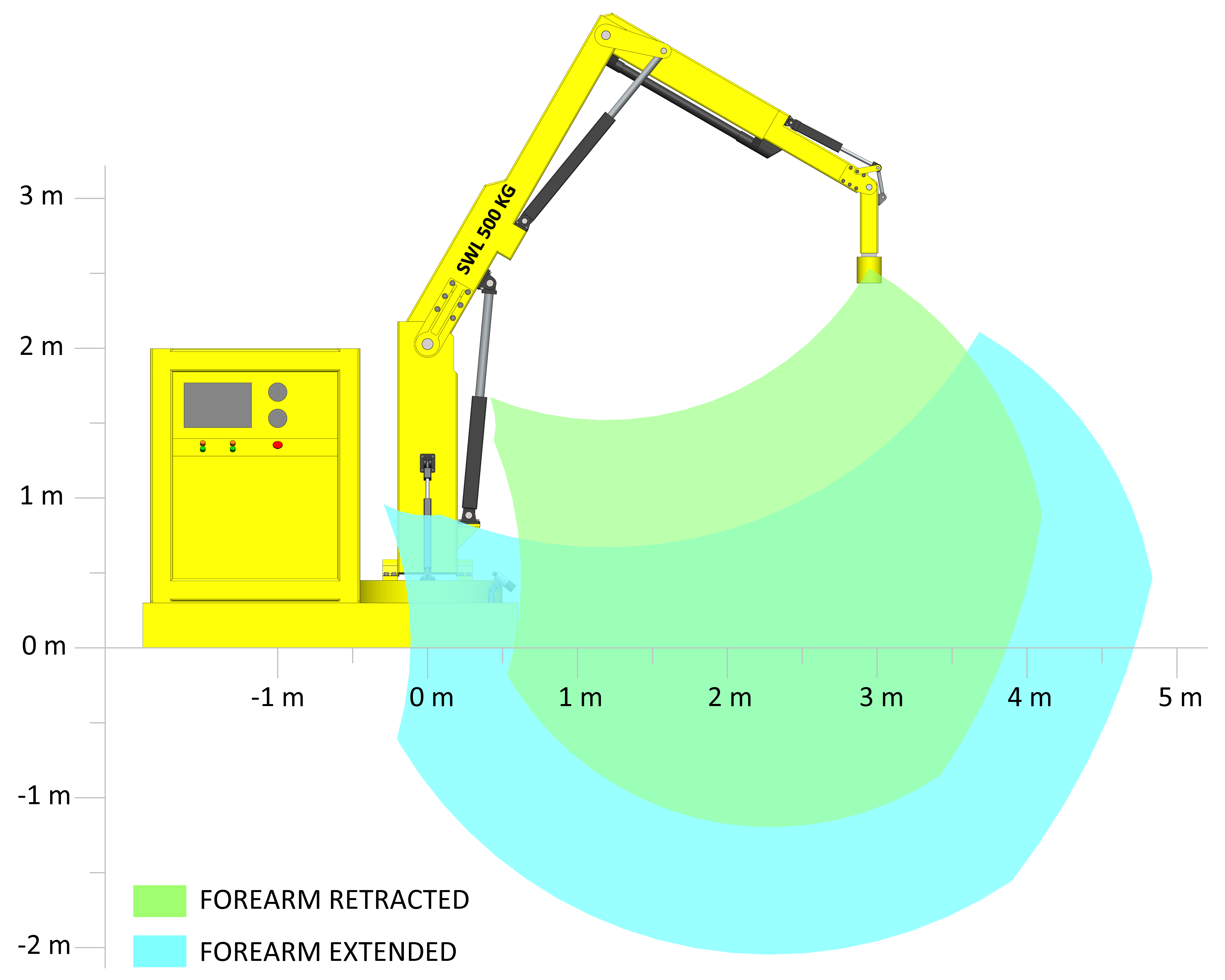
Typical launch and recovery operation using the Proteus 500 system


