Proteus Origins – Proteus Launch and Recovery System (LARS)
Part of the Autonomous Synchronised Stabilised Platform (ASSP) Project
With the rapid developments being made with Autonomous Surface Vessels (ASVs), they will play an ever increasing role in the servicing and repair of offshore installations for wind energy generation and hydrocarbon production. This is due to ASVs being able to operate around the clock in all but the most extreme weather conditions and, being unmanned, savings can be made by eliminating accommodation and equipment related to human safety. However, in order to carry out useful intervention tasks, ASVs need autonomous tools and manipulators.

With financial support from the Marine Challenge Fund (part of the ERDF’s European and Structural Funds Growth Programme 2014 – 2020, set up to boost marine innovation in Cornwall); STL Research have developed a multi-axis robotic arm for ship-based deployment.
The arm, known as Proteus, enables Autonomous Surface Vessels (ASVs) to execute intervention tasks – e.g. equipment transfers, survey and inspection, or launch and recovery operations. Space-stabilisation technology as used in STL’s Neptune personnel access system has been further developed to permit synchronous-stabilisation between two moving platforms, such as an ASV and another vessel, a floating wind-turbine, a wave-energy converter, or other target subject to wave-induced motion.
A stabilised robotic arm also has applications on-board manned vessels. For example, the launch and recovery of underwater ROVs and AUVs is time and labour-intensive, as well as potentially hazardous to personnel and the equipment itself. A robotic arm will increase efficiency, safety, availability, and expand the weather window for operations.
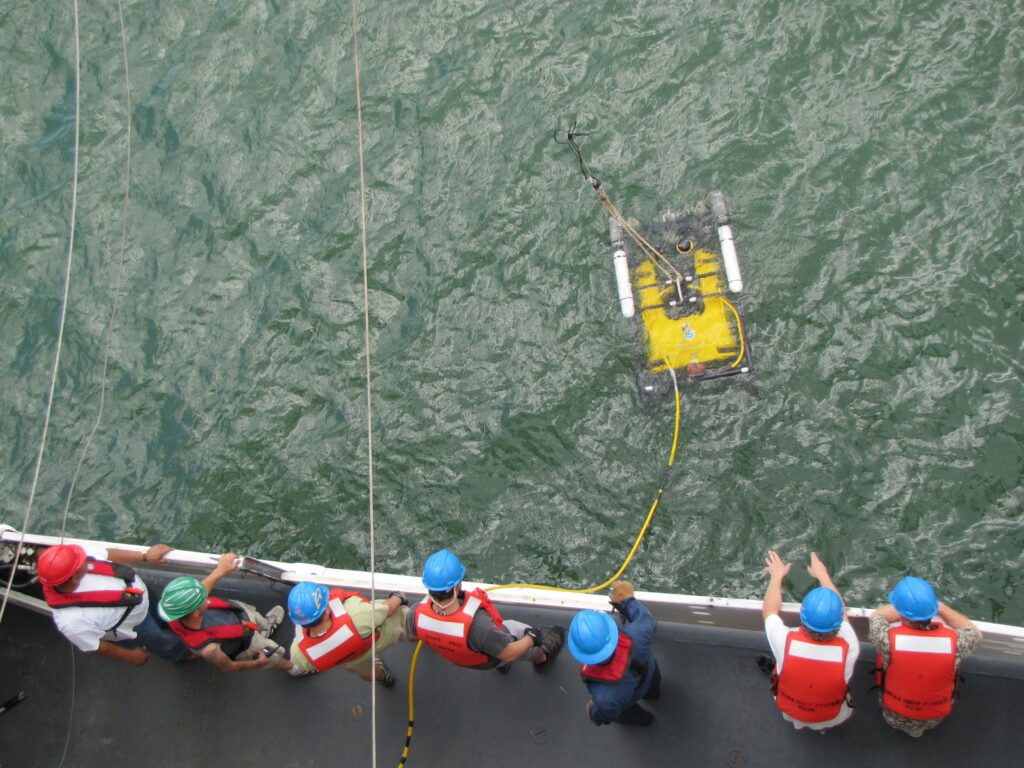
Photo Credit: NOAA Photo Photo Library (CC Licence)